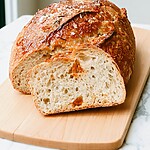
Hot Honey-Brushed Roasted Garlic Bread
This foolproof, no-knead Dutch oven bread delivers an artisan-quality loaf with a blistered crust and a wildly soft, aromatic crumb. We double down on the roasted garlic, fold sharp pecorino directly into the dough, and finish the warm loaf with a hot honey and flaky sea salt glaze—giving it a sticky, sweet-heat crunch that makes every slice irresistible.
- Total Time16 hours 40 minutes
- Yield1 loaf (serves 8) 1x
Ingredients
Scale
Roasted Garlic
- 2 whole heads garlic
- 1 tablespoon olive oil
The Dough
- 3 cups (380g) all-purpose flour, plus more for dusting
- ¼ cup (1 oz) grated Pecorino Romano or Parmesan cheese
- 1 ½ teaspoons kosher salt
- 1 tablespoon finely chopped fresh rosemary
- ½ teaspoon instant yeast
- 1 ½ cups (360ml) room temperature water
The Finish
- 1 tablespoon hot honey (or regular honey mixed with a pinch of red pepper flakes)
- Flaky sea salt (like Maldon), for sprinkling
Instructions
- Roast the garlic: Preheat your oven to 400°F (200°C). Slice the top quarter-inch off the garlic heads to expose the cloves. Place them on a square of aluminum foil, drizzle with the olive oil, and wrap the foil tightly to form a sealed pouch. Bake for 45 minutes, until the cloves are deeply caramelized and tender. Unpack and let cool for 20 minutes. Squeeze the soft garlic cloves out of their skins into a small dish and lightly mash them with a fork.
- Mix the dough: In a large mixing bowl, whisk together the flour, Pecorino Romano, kosher salt, chopped rosemary, and instant yeast. Add the mashed roasted garlic and the room temperature water. Use a wooden spoon or a sturdy spatula to stir the mixture until the liquid is absorbed and a shaggy, wet, and sticky dough forms. Ensure there are no dry pockets of flour at the bottom of the bowl.
- Let it rise: Cover the bowl tightly with plastic wrap. Leave it on the counter at room temperature for 12 to 18 hours. The dough is ready when it has roughly doubled in volume, flattened out on top, and the surface is covered in visible bubbles.
- Shape the loaf: Tear off a large sheet of parchment paper and dust it lightly with flour. Scrape the bubbly dough out of the bowl directly onto the parchment. With well-floured hands, grab the edges of the dough and pull them into the center to form a rough round loaf. Gently flip the dough over so it sits seam-side down on the parchment. Cover loosely with a clean kitchen towel and let it rest for 1 ½ hours.
- Preheat the Dutch oven: About 30 minutes before the dough finishes its resting time, place an empty Dutch oven (with its lid on) into your cold oven. Preheat the oven to 425°F (220°C) to get the pot smoking hot.
- Bake covered: Carefully remove the hot Dutch oven from the oven and take off the lid. Using the corners of the parchment paper as a sling, lift the dough and gently lower it into the pot (paper and all). Put the lid back on and bake for 35 minutes. The trapped steam is what creates the chewy crumb and tall rise.
- Bake uncovered and glaze: Remove the lid and continue baking for 15 to 20 minutes, or until the crust is a deep, crackly golden-brown. Use the parchment sling to carefully transfer the bread to a wire cooling rack. While the crust is still piping hot, use a pastry brush to sweep the hot honey over the top, then immediately sprinkle generously with flaky sea salt. Let the bread cool for at least 1 hour before slicing.
Notes
- Why it works: The extremely high hydration of this dough, combined with the heavy lid of a preheated Dutch oven, mimics the steam-injection ovens used in professional bakeries. It yields a shatteringly crisp crust and open crumb without requiring any kneading at all.
- The parchment sling trick: Don’t skip the parchment paper step. Trying to drop sticky, wet dough by hand into a 425°F cast-iron pot is dangerous and often deflates the loaf. The paper acts as a safe, easy sling and prevents the bottom of your bread from burning.
Nutrition (per serving — estimates)
Calories: 215 | Total Carbs: 41g (Fiber: 2g, Sugar: 2g) | Fat: 3g (Saturated: 1g) | Protein: 6g
Nutritional values are approximate, based on standard reference data (USDA FoodData Central). Actual values vary by brand and exact measurements. For precision, use a tracker like MyFitnessPal or Cronometer.
- Prep Time: 15 minutes
- Resting Time: 14 hours 50 minutes
- Cook Time: 1 hour 35 minutes
- Category: Bread
- Method: Baking
- Cuisine: American
Nutrition
- Serving Size: 1 slice
- Calories: 215
- Sugar: 2g
- Fat: 3g
- Saturated Fat: 1g
- Carbohydrates: 41g
- Fiber: 2g
- Protein: 6g