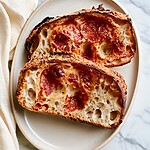
Parmesan-Crusted Pepperoni Pizza Sourdough
A savory, crackling parmesan-garlic crust gives way to a chewy crumb studded with gooey mozzarella pockets, spicy pepperoni, and aromatic oregano. By slightly lowering the dough’s hydration compared to standard sourdoughs, this loaf gains the structural strength to handle heavy mix-ins without weeping oil or turning gummy in the center.
- Total Time19 to 28 hours
- Yield1 loaf (serves 10) 1x
Ingredients
Scale
The Dough
- 330g warm water, about 85°F (1 1/3 cups + 1 tbsp)
- 90g active sourdough starter, bubbly and peaked (1/3 cup + 1 tbsp)
- 450g bread flour (3 1/2 cups)
- 8g fine sea salt (1 1/2 tsp)
The Pizza Fillings
- 140g low-moisture block mozzarella cheese, cut into 1/2-inch cubes (5 oz)
- 115g sliced pepperoni, quartered and patted dry (4 oz)
- 1 tbsp dried oregano
- 1/2 tsp crushed red pepper flakes (optional)
The Crust Finish
- 2 tbsp grated Parmesan cheese
- 1/2 tsp garlic powder
- 2 tbsp rice flour or semolina flour (for dusting)
Instructions
- Mix the dough: In a large mixing bowl, whisk together the warm water and active sourdough starter until milky. Add the bread flour and mix by hand or with a dough whisk until all dry spots are absorbed. Cover with a damp towel and rest for 45 minutes.
- Add salt and build strength: Sprinkle the sea salt over the dough. Wet your hands and dimple the salt into the surface, then knead gently in the bowl for 2 to 3 minutes to build early structure. Cover and rest for 30 minutes.
- Laminate the inclusions: Lightly mist your countertop with water. Turn the dough out and gently stretch it from the center outward into a large, thin, semi-translucent rectangle. Evenly scatter the mozzarella cubes, quartered pepperoni, dried oregano, and red pepper flakes over the surface. Fold the left third of the dough over the center, fold the right third over that, and roll it up tightly from the bottom into a cylinder. Return to the bowl, cover, and rest for 45 minutes.
- Bulk fermentation: Perform 3 sets of coil folds (lifting the dough from the middle and letting the ends tuck under itself), spacing them 45 minutes apart. After the final fold, cover and let the dough rise at room temperature until it feels airy, jiggles slightly, and has grown by about 40 to 50 percent in volume. (Note: Total bulk fermentation time will vary based on your kitchen’s temperature).
- Shape and coat: Turn the dough out onto a bare counter. Using a bench scraper, gently shape it into a tight boule (round) or batard (oval), being careful not to tear the surface over the cheese cubes. On a small plate, mix the Parmesan cheese and garlic powder. Lightly mist the top of your shaped loaf with water and roll it gently through the Parmesan mixture.
- Cold retard: Dust a banneton basket with rice flour or semolina flour. Place the dough into the basket seam-side up. Cover tightly and refrigerate for 12 to 18 hours.
- Bake covered: Place a cast-iron Dutch oven (with the lid) into your oven and preheat to 475°F (245°C) for 1 hour. Turn the cold dough out onto a sheet of parchment paper. Score a single, deliberate slash slightly off-center using a bread lame or sharp razor. Carefully transfer the parchment and dough into the hot Dutch oven, cover with the lid, and bake for 20 minutes.
- Bake uncovered: Remove the lid and drop the oven temperature to 450°F (230°C). Continue baking for 20 to 25 minutes, or until the Parmesan crust is deeply browned and the internal temperature of the bread reaches 205°F (96°C).
- Cool completely: Transfer the loaf to a wire cooling rack. Allow it to cool for at least 2 to 3 hours before slicing to allow the crumb to set.
Notes
- Why it works: Cubing the mozzarella instead of shredding it is the structural secret here. Shredded cheese melts entirely into the dough matrix as it bakes, which inhibits gluten and creates a dense, gummy loaf. Cubes stay localized, creating distinct pockets of melted cheese while allowing the surrounding bread to rise properly.
- Hydration management: Pepperoni renders fat when baked. Because this dough is mixed at a slightly lower hydration (around 76% when accounting for the flour and water in the starter), it is sturdy enough to absorb that rendering oil without turning into a sloppy, flat mess. Always pat your pepperoni dry before laminating to help this process.
Nutrition (per serving — estimates)
Calories: 277 | Total Carbs: 36g (Fiber: 1g, Sugar: 1g) | Fat: 9g (Saturated: 4g) | Protein: 13g
Nutritional values are approximate, based on standard reference data (USDA FoodData Central). Actual values vary by brand and exact measurements. For precision, use a tracker like MyFitnessPal or Cronometer.
- Prep Time: 30 minutes
- Resting Time: 18 to 27 hours (varies by temperature)
- Cook Time: 45 minutes
- Category: Bread
- Method: Baking
- Cuisine: American
Nutrition
- Serving Size: 1 slice
- Calories: 277
- Sugar: 1g
- Fat: 9g
- Saturated Fat: 4g
- Carbohydrates: 36g
- Fiber: 1g
- Protein: 13g