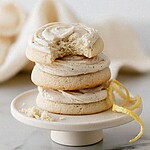
Lemon Meltaway Cookies with Vanilla Bean Glaze
These incredibly tender, buttery cookies practically dissolve on your tongue, leaning on a heavy dose of cornstarch and a lower baking temperature to maintain their delicate texture. Rubbing fresh lemon zest directly into the sugar releases essential oils for a brighter citrus punch, while a speckled vanilla bean glaze gives them a gorgeous bakery-style finish.
- Total Time79 minutes
- Yield36 cookies (serves 36) 1x
Ingredients
Scale
Lemon Meltaway Dough
- ⅔ cup (135 g) granulated sugar
- 1 ½ tablespoons freshly grated lemon zest (about 2 medium lemons)
- 1 cup (226 g) unsalted butter, softened to room temperature
- 1 ¾ cups (210 g) all-purpose flour
- ⅓ cup (40 g) cornstarch
- ½ teaspoon kosher salt
Vanilla Bean Lemon Glaze
- 1 ½ cups (180 g) powdered sugar, sifted
- 2 to 3 tablespoons fresh lemon juice
- 1 teaspoon vanilla bean paste (or pure vanilla extract)
- Pinch of kosher salt
Instructions
- Prep oven and pans: Preheat your oven to 325°F (165°C). Line two large baking sheets with parchment paper.
- Rub the lemon sugar: In a large mixing bowl or the bowl of a stand mixer, combine the granulated sugar and lemon zest. Use your fingertips to aggressively rub the zest into the sugar for about a minute. The sugar will become highly fragrant, feel like wet sand, and take on a pale yellow color.
- Cream the butter: Add the softened butter to the lemon sugar. Beat on medium-high speed for 2 to 3 minutes, until the mixture is visibly pale, light, and fluffy.
- Mix the dry ingredients: In a separate medium bowl, whisk together the flour, cornstarch, and kosher salt. Turn the mixer to low speed and gradually add the dry mixture to the butter, mixing just until a soft dough forms (stop as soon as the flour streaks disappear to avoid overworking the dough).
- Shape and flatten: Scoop the dough into 1-tablespoon portions and roll them gently between your palms to form smooth balls. Place them on the prepared baking sheets about 2 inches apart. Use the flat bottom of a drinking glass (lightly dusted with flour or powdered sugar if sticking) to gently press each ball down to about ½-inch thickness.
- Bake: Bake on the center rack for 12 to 14 minutes. The tops should look dry and set, but the cookies must remain pale—do not let the edges brown, or they will lose their signature melt-in-your-mouth texture.
- Cool: Let the cookies rest on the baking sheets for 5 minutes (they are very fragile when hot) before carefully transferring them to a wire rack to cool completely.
- Whisk the glaze: While the cookies cool, combine the powdered sugar, 2 tablespoons of the lemon juice, vanilla bean paste, and a pinch of salt in a small bowl. Whisk until perfectly smooth. If the glaze is too stiff, add the remaining lemon juice a few drops at a time until it reaches a thick but spreadable consistency.
- Glaze the cookies: Spoon about a half-teaspoon of glaze onto the center of each completely cooled cookie. Use the back of the spoon to swirl it gently toward the edges. Let the cookies sit at room temperature for about 30 to 45 minutes so the glaze can set firm before serving.
Notes
- Why it works: Swapping a portion of the flour for extra cornstarch weakens the gluten structure, guaranteeing that ultra-tender, shortbread-like “meltaway” crumb. Baking at a lower temperature (325°F instead of 350°F) ensures the cookies bake through without taking on any crisp, brown edges.
- Flattening tip: Flattening the dough balls before baking is much safer than pressing them after they leave the oven. Post-bake pressing often causes delicate meltaways to crack and crumble.
- Storage: Store the glazed cookies in an airtight container at room temperature for up to 5 days. Place parchment or wax paper between the layers to protect the glaze.
Calories: 104 | Total Carbs: 14g (Fiber: 0g, Sugar: 9g) | Fat: 5g (Saturated: 3g) | Protein: 1g
Nutritional values are approximate, based on standard reference data (USDA FoodData Central). Actual values vary by brand and exact measurements. For precision, use a tracker like MyFitnessPal or Cronometer.
- Prep Time: 20 minutes
- Cooling Time: 45 minutes
- Cook Time: 14 minutes
- Category: Dessert
- Method: Baking
- Cuisine: American
Nutrition
- Serving Size: 1 cookie
- Calories: 104
- Sugar: 9g
- Fat: 5g
- Saturated Fat: 3g
- Carbohydrates: 14g
- Fiber: 0g
- Protein: 1g